Know what your business is worth — before someone else tells you.
Independent DCF, comparable-company, and financial-buyer (LBO) analysis for a raise, a buy-or-sell decision, or planning — a defensible number you can stand behind, not a guess.
Engagements from $4,500 — fixed fee, agreed in writing before any work starts.
When you need this
The situations this is built for.
You're raising equity, and the valuation decides how much of the company that money costs you.
A partner is buying in — or buying out — and both sides need a number they can trust.
You're thinking about selling in the next few years and want to know where you stand today — and which levers move the number.
A buy-sell agreement, succession plan, or major planning decision needs a figure with reasoning behind it.
The process
How the engagement works.
Three independent methods, every assumption documented, and a number built to survive the other side of the table.
01
Scope the purpose
A valuation for a raise, a partner buyout, and long-range planning are different exercises. The first call establishes what the number is for, who will challenge it, and what depth the situation actually needs. You'll know the scope and the fee before any work starts.
02
Normalize the earnings
Owner-led P&Ls carry owner compensation, one-time costs, and family payroll that a buyer or investor would strip out. I adjust to the earnings the business actually produces — usually the single biggest swing in the whole valuation.
03
Build the DCF
A cash-flow forecast built from your operating drivers, a discount rate built up and documented — the same discipline as my public-market work: cross-checked against institutional opinions and peer-group calculations — and a terminal value with its logic stated, not assumed.
04
Cross-check against the market
Comparable-company multiples and a financial-buyer (LBO) analysis — what a private-equity or independent-sponsor buyer could pay with leverage and still clear its return — as independent second and third methods. The LBO reads the deal from the buyer's side: the price a financial buyer can justify, which usually sets a floor a strategic acquirer would clear. When the number is for a sale or a buyout, that buyer's-eye view leads the cross-check. Where the methods disagree, I find out why — that gap is usually where the real insight about your business lives.
05
Deliver — and defend
A written summary, a sensitivity table showing exactly what moves the number, and a walkthrough. When the other side pushes back, every assumption has a documented answer.
Three methods, one rangeWhy the number stands on more than one leg
Every press nudges the assumptions at random — watch the overlap hold.
The real thing · interactive
Explore a working valuation.
Illustrative — DCF, trading comps & an LBO triangulated into a range. Drag the discount rate; example numbers, not client data.
Deliverables
What you walk away with.
Independent DCFBuilt from your financials, with every assumption documented
Market cross-checkComparables and a financial-buyer (LBO) analysis — the number stands on more than one leg
Sensitivity tableWhat moves the number, and by how much
Written summaryReady to put in front of a buyer, partner, or investor
Packages & pricing
Pricing, in the open.
Fixed fees, agreed in writing before any work starts — no hourly meters, no surprise invoices. For context: a fractional CFO typically runs $3,000–8,000 a month and a full-time financial analyst $85,000+ a year. This work is priced at the floor of the specialist market — senior-grade deliverables, right-sized fees, and every build is yours to keep.
Decision-grade valuation
$4,500
One-time · fixed fee
Independent DCF with every assumption documented
Comparables + financial-buyer (LBO) cross-check
Sensitivity table — what moves the number, by how much
Written summary + walkthrough, ready for the other side
Founding rates are honored for the life of the engagement and are limited to my first five clients. Complex scopes (multiple entities, unusual data) are quoted on the call — always fixed before work begins.
Designed for strategic planning and transaction support. Formal tax, litigation, fairness-opinion, or certified-appraisal engagements require separate scope with the appropriate professionals.
Where the money is
What a defensible number is worth.
In every one of these situations, the valuation isn't paperwork — it's the price.
Equity you keep
In a raise, the valuation is the deal. A number you can defend line by line anchors the negotiation; a number you can't is an invitation for the other side to set the price for you.
The sale that doesn't leave money behind
An underpriced business is a gift to the buyer; an overpriced one never closes. A supportable range — with the reasoning visible — is what gets deals done at fair value.
The buyout that stays civil
Partner buy-ins and buyouts fall apart over two competing guesses. An independent number both sides can interrogate replaces argument with arithmetic.
"A valuation is a range with reasons — not a magic number. Anyone who hands you a single figure with no sensitivities is selling confidence, not analysis."
Straight answers
What this is — and isn't.
Is this a certified appraisal for court or tax filings?
No — this is decision-grade analysis for raises, buyouts, sales, and planning. If your situation requires a formally credentialed appraisal for litigation or tax purposes, you'll be told in the first call and pointed in the right direction.
What do you need from me?
Three to five years of financials, current interim numbers, and an hour of your time on how the business actually works. The normalization step is where owner knowledge matters most.
Why three methods?
Any single method can be argued with. When an independent DCF, market comparables, and what a financial buyer could actually pay point to the same range from different directions, the number gets much harder to dismiss.
Briggs research · Note 01 — not a client engagement
An independent DCF on a public company — built to be checked, line by line.
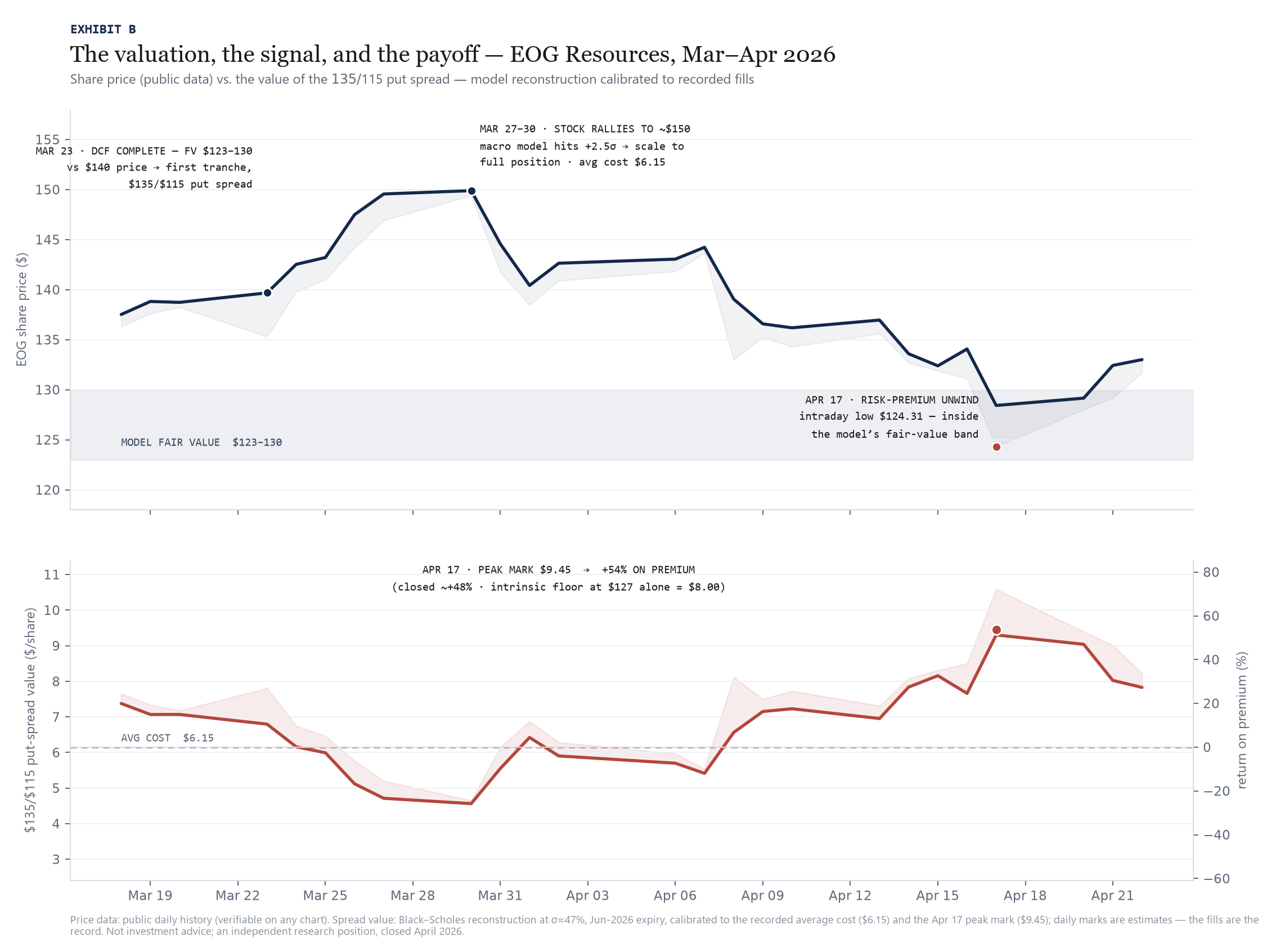
A research note on EOG Resources (NYSE: EOG), built entirely from the company’s public SEC filings. The discounted-cash-flow model put fair value near $123 a share against a market price around $149 — a gap the model attributes, assumption by assumption, to a geopolitical risk premium in oil prices. I hold this practice’s research to the same standard as client work: build the model, put the number on record, and let reality grade it — so the view was expressed in the market with defined risk, and the outcome is logged below. Not a stock recommendation. The full 17-page pitchbook follows; the operating model itself is available on request.
The payoff — and how anyone can verify it
The positionLong $135 / short $115 put spread — first tranche Mar 23, 2026 near $140, scaled to a full position Mar 27–31 as the stock rallied to ~$150 and the macro signal strengthened. Average cost $6.15 a share.
The moveEOG fell toward ~$127 by mid-April 2026 — the price path is on any public chart.
The mathAt $127, the $135 put holds $8.00 of intrinsic value by definition ($135 − $127) — no options model required. That intrinsic floor alone is +30% on the $6.15 paid; exiting before expiry, the spread still carried time value on top.
The resultClosed at roughly +48% on the spread as the gap closed toward the model's $123 fair value — the full trade record is logged in the pitchbook.